


TWO-TIME WORLD CHAMPION BOXER REGIS “ROUGAROU” PROGRAIS TALKS ABOUT HIS LIFE, CAREER & HIS NEW BOOK ( Full Interview)

Interview by Raquel Miller

Regis “Rougarou” Prograis has never been just a fighter—he’s a thinker, a storyteller, and a student of the game. In an intimate and wide-ranging conversation with Raquel Miller, the two-time world champion reflects on his journey from New Orleans to the world stage, the mental discipline that fuels his success, and the life lessons that extend far beyond the ring. The interview offers rare insight into Prograis’ evolution as both a boxer and a man, setting the stage for a story rooted in resilience, reinvention, and legacy.
Raquel Miller: First and foremost I want to thank you for being here. I’m Raquel Miller. I’m actually a pro boxer as well so I’m excited to do this.
Regis Prograis: Ok, that's what’s up!
Raquel Miller: I am a So FN Dope alumni as well. I was asked to grace their cover before and they are just dope, so I’m always here to interview with them or help and support them in any way I can because they are just super dope to me as a whole. We are excited to have you here as part of the So FN Dope family.
Regis Prograis: Thank you. Thank you.
Raquel Miller: One of the founders of the magazine is from New Orleans and he would kill me if I didn’t ask you “WHAT WARD YOU FROM”? Wuzzam…. [Laughs]
Regis Prograis: I’m from the East. If you are not from New Orleans, you can say the Ninth Ward. People that know me, know that I grew up in the East, but I started boxing across the canal, and that’s the Ninth Ward. I kind of go both ways, but really I feel like I rep the whole city of New Orleans. A lot of people from the Ninth Ward want to claim me but a lot of people from The East want to claim me too, but I also went to school in the Sixth Ward, so I feel like I represent the whole city of New Orleans.
Raquel Miller: I love that! It is like that, especially when you box, everybody wants to say that you are their people.
Regis Prograis: Exactly. Everyone claims you.
Raquel Miller: So your nickname ‘Rougarou’ ties into Cajun folklore — part beast, part protector. Tell me how that name came about and what is the mindset behind that?
Regis Prograis: So it came about when I was 4-0 at the time and I didn’t have a nickname. My manager, trainer at that time, and my dad were going back and forth between nicknames. They were throwing out different names like “The Cajun City Crusher” , “NOLA Knuckles”, I remember that one.They were saying stuff like Regis “Rifleman” Prograis. I was like “What!!! Nah”. So they were saying all kinds of things like that and then one day my daddy said “Rougarou” and my manager at the time said “ That’s it!” I’m not going to lie, at first, I didn’t like it. I didn’t even know what it was, because I’m from Louisiana, but we are from the city. Being from New Orleans, we are city boys. Everybody thinks it’s the country, but New Orleans is a big hub and everybody goes there so we don’t do country stuff out there. Rougagou is more like country, small town, backwoods Louisiana folklore stuff. But my dad came up with “Rougarou”, and even though I didn’t like it at first, it really stuck with me when I fought my tenth fight here in Houston, and I came out with the mask on and everybody went crazy. Everybody was doing the wolf howl. Then I was like “Damn! This is it”. I came out like I always wanted to come out. For me, my idol was Mike Tyson growing up. He used to come out with no shirt, the small black shorts and a towel on. I still have a picture of that. I always wanted to do that. So I came out with small black shorts, no shirt and instead of the towel, I had the mask on and everybody went crazy. I knocked the dude out in the second round and that was it. That was the beginning of the “Rougarou”.
Raquel Miller: You have a lot of New Orleans rhythm and swag and with your whole persona and where you’re from— Tell me how much does home influence your style and your movement in the ring?
Regis Prograis: For me, with the fighting, I think New Oleans is in me. I have two stories with boxing. Obviously I grew up in New Orleans. I started fighting on the streets of New Orleans, but then I took it to a whole different level in Houston, obviously when I turned pro, but really when I came to do amateur boxing. Of course the whole New Orleans thing it’s just something that is in me. My whole swag and everything. My mama still lives there. My grandma lives there. I actually own more houses there in New Orleans than I own anywhere else. All my friends live there. It's home for me no matter where I live. It’s crazy because I’ve been living outside of New Orleans now, longer than I lived in New Orleans. The storm hit when I was 16 and I’m 36 now. I’ve literally been living in Texas for 19 years now and I left when I was 16. So New Orleans is always home. I’ll be honest with you. I don’t feel home anywhere else other than when I’m in New Orleans. I’ve traveled to so many places, but when I’m there I feel home.
Raquel Miller: So, you left when Katrina happened. Is that what made you leave or was it boxing to go with different coaches and trainers?
Regis Prograis: I did originally leave because of Katrina, but I stayed because of boxing.
Raquel Miller: Okay. I gotcha.
Regis Prograis: Yeah, If Katrina would not have hit, I never would’ve been in the place I’m in for sure because New Orleans is a fun city. They call it the Big Easy for a reason. Everybody out here lives easy. People out there don’t really care about careers too much. They don’t really care about money. They just really like to enjoy themselves, and that is a good way to live if you really think about it. But they don’t really have money and stuff. When I was younger, I always felt like I wanted to do more. I wanted to be more than what I was raised around. I love the culture but I always felt like I was more than that. I wanted to explore. It’s great to have the culture, but for me I wanted to see the world. I wanted to travel and a lot of people just don’t do that. They are stuck in New Orleans. Another thing people don’t realize is that if you can make it in New Orleans, you can make it in a lot of places. New Orleans has so much culture behind the city. But when you live in the city, you don’t understand it. You don’t see it. You don’t know how blessed you are when you stay in the city the whole time. That’s all you know, but when you go to other places, and I’ve been all over the world, and you realize ”Damn, New Orleans is really special” and there is really no place like New Orleans. So for me, like I said, New Orleans is always home.

Raquel Miller: Yes, and I also have to shout you out , because you are the first 2x World Champion from New Orleans, so congratulations on that. That is huge. I’ve got to give you your flowers on that. So I’ve got a question. A lot of times when people hear that we fight, they automatically think of it from a lens of just violence, but it is really so much more than just violence. There are decisions. You're playing chess. You're thinking. You're adjusting. Tell me what it is for you, when you get in that ring besides the violent aspect of the sport. What’s on your mind? What are you thinking when it is game time?
Regis Prograis: When I first started, I was violent. You don’t understand it until you get older. I think I had a lot of frustrations from my childhood. When I was younger I just always loved to fight. I did karate and I got kicked out because I was just too rough. I hurt somebody. They told me I was too rough. But ever since I was young, I just always loved to fight. I also had childhood things going on that made me more angry and that was my outlet, I guess. But then, as I got older I really started trying to be a student of the sport and really learn because when I was coming up, I just wanted to hurt everybody. That’s all I wanted to do. I literally got in the ring and wanted to hurt them as much as I could. One thing about me is that I’m really tough. I can take punishment. Especially when I was younger. I could take punishment. You could hit me as hard as you can. It’s not going to do nothing, but if I hit you… I’m going to hurt you. I know I’m going to hurt you. That was kind of always my gameplan. You could hit me 10 times, but when I hit you this one time, I’m going to hurt you. But then I got older, and now it's more of the sweet science. I want to become more of a boxer now. I mean, I still got that savage in me, but I don’t have to bring it out, and that is what my coaches tell me now. The crazy thing is they tell me ”Don’t worry about the Rougarou no more. That shit should die. You could become a boxer now”. That’s where I’m headed now in my career to become more of a boxer, because the heart is always going to be there. I can fight anytime I want to. I can take an ass whoopin, I can take a punishment, but now it’s becoming more of the sweet science, than anything. That is kind of what this era is bringing up now because Floyd was so successful. Now it’s not about the savages anymore like it used to be. For me I loved Tyson and Henry Armstrong, Duran, and Hagler– you know people that were just savages. But now we have people like Floyd and Terrance Crawford, and of course Ray Leonard back in the day, who really practiced the sweet science. I feel like I’m leaning more in that direction as well. Of course I have to because I’m getting older too.
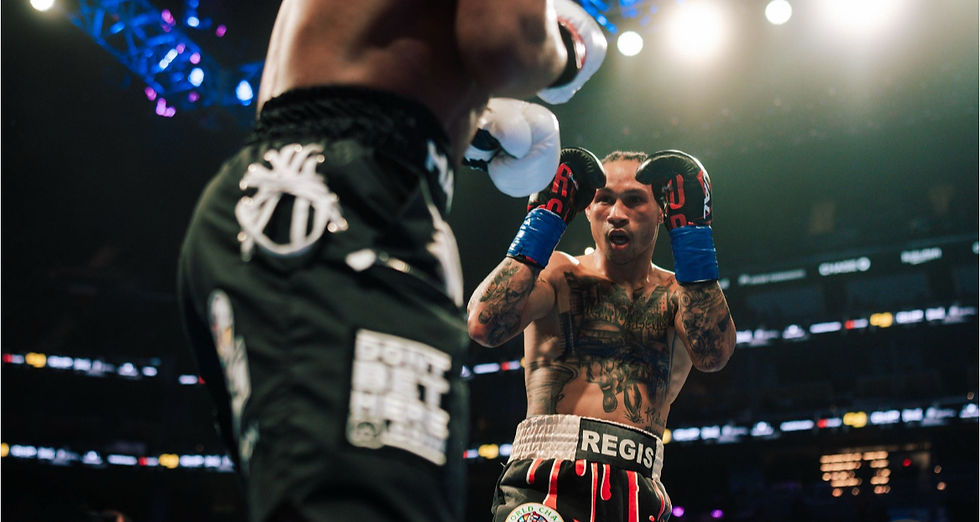
Raquel Miller: That makes sense. With the times changing and so many people trying to protect their 0 and you being a person that has dealt with the highs and the lows of the sport, how do you keep your mindset intact, how do you feel like, no matter what happens, “I’m still me… I’m still HIM”?
Regis Prograis: Oh for sure. Because I know that. I think it is from experience. You have to go through those things. For me I’m grateful for my “L’s”, [my losses] because without them it wouldn’t have made me who I am right now.. I would not have ever become a 2x champion if I would not have lost the first time. I don’t know what would've happened if I wouldn’t have lost to Josh Taylor. I still think I beat Josh Taylor, but — I lost and I came back three years later, and I came back stronger and became a 2x champion. And so now my goal is to become a 3x champion. But for sure I wouldn't be where I’m at if it were not for that. Everybody tries to protect their 0 but at the end of the day it really doesn't matter. People asked me after the Josh Taylor fight how I was feeling, and I was like” Bro I’m so good” I felt so good. The thing is, sometimes your personal life might be so good and then the boxing life the opposite. Because my life is two different things. I have a boxing life and then I have a personal life. In my boxing life at the time I had lost, but my personal life was great. So people were asking me ”Man, how are you doing? How are you feeling”? And I was like “ What? I feel great”. I was living in L.A. at the time. Then I went to Hawaii. I was traveling. You’re talking about someone who had never done any of that stuff before. You got all this money. Traveling. Living the dream life. So you’re talking about a loss? I mean I don’t even really care about that right now at that time. For me, I box because I really love boxing. Everybody is asking me right now “ Hey are you retired?” I’m like “Hell nah!” Why would I retire? I love it. I really love the sport. I still truly love boxing and that is why I succeed because I really love it.
Raquel Miller: Do you love the competition? Do you love the art of war? When you say you love it, what do you love most? Do you love the training camps, the preparation and how you have to be mentally locked in? Because at the end of the day you’re a performer and you’ve got to go perform and you’ve done a great job performing. So what do you love most about it?
Regis Prograis: I love so many things about it. I do love the training camp. The first thing I can think of off the top of the head is I love walking to the ring. I do love being in the dressing room. I love warming up. I love the competition. I’m at a different stage in my career. It feels like I’m starting over which feels really good. I did my last camp in Vegas and I’ve never done that before. I mean, I’ve trained in L.A. and I've trained in Vegas, but I’ve never done it like I’m doing it right now. My last was the hardest camp I’ve been through in my life mentally, physically, and emotionally. Mentally, just because of how hard it was. It was so hard during the first two weeks, I told my partner that cooks for me, he’s my assistant, I told him I don't think I can do it. We had eight weeks and after 3 weeks I was like “Damn, I got five more weeks of this shit to go”.
Raquel Miller: [Laughs] People don't understand that! Tell the people the different phases of camp, because they don’t understand what it is to take your body through a rigorous workout. Literally for me when I’m in camp, the only day I have off is Sunday. You’re there for three days of training and the other days I do strength and conditioning. You’re making weight. You usually have late night runs or early morning runs and just the mental exhaustion it takes to be locked in that space and also for me. I’m usually laughing and smiling but when it’s fight time I feel like I’m a different person. I mean, I’m on edge, because I’m about to go to war. So tell the people what it really looks like to be in training camp and get through those eight weeks.
Regis Prograis: It's just so hard. I’ll give you an example, but before I even get to that, the hardest part was the emotional part. I have three kids and they are getting older now. So you miss so much stuff. My son just made 12 on the 20th and one of my daughters is making 5 on the 1st which is on Saturday. So sometimes I miss things like that. Like last year, I missed both of their birthdays. My little one made 4 last year so she is not going to really realize it but my son turned 11 last year and I couldn’t be there. So that is the hardest thing, the emotional part, but as far as the physical part, my second day of camp, I got to the gym. My coach was like “Yeah, go run”. I was like “Cool, how much?” He was like “Eight miles”. On my second day! And I’m training in Vegas. It’s hot. I’m not used to the weather. It was summer time and we trained so hard. That run was basically a warm-up. That is how hard it was.
Raquel Miller: Wait a minute! He wanted you to run eight miles and then go train?
Regis Prograis: Yes!!! That is the thing. He’s like” Go run the eight miles” and when I got done, he was like “Ok, now it’s time to work”.
Raquel Miller: Oh so you working … working!
Regis Prograis: My camp was so hard, and then that was considered just one work out. We were doing three workouts a day. And then you’ve got to think about it, you’re not around anybody and I’m missing my kids, so it’s mentally draining. But that is what I was saying, the first two or three weeks I wasn't sure if I would make it. My body was just dead. Luckily I got hurt at camp. I know it’s crazy to say luckily, but I got hurt so I had to take off a little bit so I was like “thank you — I can take off a little while I need this” [ Laughs] But now, whenever I go back to Vegas to train, I am mentally more prepared now, because that was my first time doing a whole camp in Vegas and really doing a whole camp away from my family. And I feel like at this stage, I needed it because I never did it before.
Raquel Miller: Yeah, and you hardly have any distractions.
Regis Prograis: No distractions. Yeah, No distractions.
Raquel Miller: I’ve seen you walk out to so many artists. If you had to pick out an artist or soundtrack that describes your sound or your life, what would it be?
Regis Prograis: Perfect question! Right now. It’ll be Lil Wayne. Lil Wayne is my favorite artist. I actually know Lil Wayne too. That is my favorite artist of all time. It’ll be Lil Wayne “Let It All Work Out”.
Raquel Miller: Okay… I like that. I like that!
Regis Prograis: Right now, that is like my favorite song. Because I’ll sit back and be going through some personal stuff. And really, when you do things in the right way–everything you’re supposed to do. For me, I have a lot of steps that I might do. I might read, I may watch my boxing, I pray, I meditate and when you do those things that are going to show success, it really does just work itself out. Maybe I will or maybe I won’t but I always tell my people that I might walk out to that song for the rest of my career.
Raquel Miller: I love that. You just made me remember, that everytime I hear that song, it just makes me feel like” You know what… It’s all going to work out”. And like you said, when you trust the process and you meditate, when you’re reading and when you are just keeping your mind strong, because I personally think that boxing is more mental than physical. Of course, it is really really physical, but the mental is really going to take it to the next level, which brings me to my next question. Well not necessarily a question, but I wanted to congratulate you on your new book. That’s super dope. I’m excited about it. I’m a reader as well, so just to hear that you’re a reader and a boxer, I love that. So tell me about the book. Tell me about why you wrote it. Give me all of the gems. I need that.
Regis Prograis: Alright so my partner, Ross Williams, wrote the book for me. I’ve known Ross since elementary school but the crazy story is that I didn’t like Ross when I first met him. I did not like him. I wanted to whoop Ross’s ass. I tell him all the time. Just a little history about that. As kids, Ross and I played basketball and his dad was the coach. We played the same position and I was always saying “Man, I didn’t get no PT because of Ross”. I wasn’t any good at basketball. He was better than me, but I always say “I’m never going to get any PT because of Ross”. But anyway I didn’t like Ross, but we reconnected when we were older and he had a podcast. I did his podcast before. He also wrote books and I had read two of his books and I was like “Bro your books are really good”. He was like ”I appreciate that. You know what? We need to do one”. This was in 2017 or 2018 when we were talking about the process and we dropped it about a year ago. It’s called Stories and Lessons. It’s an autobiography. Just all of the stuff that I’ve been through. I know that I’ve been through a lot and I can really share a lot of things. People think that it is about boxing, but it’s really not. There are funny stories in there— sad stories and a lot of lessons that I learned. A lot of people look at life like if you fail at something, then that is it. I look at life as a lesson. Literally. Just learn from it.
Raquel Miller: Exactly, because you can bounce back from anything. I totally agree with that. You can bounce back, or you can change your life, you can do anything you want to do. It’s all about your mindset. So in the book, was there ever a part where you felt like it was a little too personal or were you ok with just sharing openly whatever your stories were? Did you want to hold back some or were you like, “It is what it is”?
Regis Prograis: Nah…So for me. I approved everything in the book. I told him about a lot of things in the book. I had to read the book so many times. I read it so many times I got sick of my own book. But the process was good. I don’t have anything that I would’ve held back. I probably would’ve put more in there. The book could’ve been way longer but it's long enough for now. So right now we are working on part two and part two is way better. Part one is good, but I just know part two will be better because I went through way more stuff at this second stage of my career, than I did in my first stage. So it’s going to be like The Carter II. I say references to Lil Wayne. That Carter I was good, but that Carter II was on a whole different level. That’s how it’s going to be.

Raquel Miller: So you call yourself a fighter / reader. What book changed your life or challenged you or what book would you recommend that could help them in any part of their life. What would you recommend?
Regis Prograis: That is a really really good question. I’m in my office right now. So all my books are here so I can really look at them right now. Hmmmm.
Raquel Miller: I could go first, if you can’t think of yours yet. I think Alchemist is a book that I would always recommend to people.
Regis Prograis: The Alchemist? That is a good book. So I just read this book called Psycho-Cybernetics. That’s a really good book. For me now. I read so much, I have to have really good books. Same as if you’re into wine or or watching movies. To keep your interest you have to have the really really good stuff. So now I’m reading international bestsellers, something that the whole world can read. The Alchemist is one of them actually, but this book I have Psycho-Cybernetics is basically about, You can think positively, but you will never get anywhere unless you change the way you look at yourself. I’m really big on the power of the mind and all that type of stuff and that is how I got where I’m at because I started boxing really late, but I had to believe in myself. It really is about confidence and believing in yourself.
Raquel Miller: What do you want someone to gain from your book after they read it?
Regis Prograis: Just like I was saying earlier, the main thing is not to take defeat personally. I mean take it personally, but don’t let it get you down. Just come back up from it. Anything in life, just learn from it. If you learn from it, you’ll come out way better. For me, I read a lot of biographies and autobiographies and everytime they come back from something and become great. Basically, I feel like no one can become great at something if they don’t fail at it first. Michael Jordan says he missed over 9,000 shots in his career. Oprah had so many heartaches but you learn from it and bounce back from it. That is what I want people to know– you bounce back from things. For me, it is easy to say those things but, when you really hear about what happened and read examples in my book you can really relate to it. Because it is easy to say things, but when you know the real story behind it then you can relate to it a little more.

Raquel Miller: So pivoting back. You’re a world champion. You’ve fought all over the world. What is the difference between fighting somewhere like Vegas or L.A. vs fighting at home? What is the biggest difference?
Regis Prograis: I ain’t gonna lie. It might sound bad, but fighting at home is terrible. Oh man, it is terrible.
Raquel Miller: [Laughs] Come on—You gotta tell me more. Why?
Regis Prograis: Because you're so bombarded by everyone. Every time I fought in New Orleans, it wasn't good. I would rather fight somewhere new. You don’t want to fight in someone else's hometown, but you don’t want to fight in your hometown either because there are so many distractions. People are dealing with you about tickets. I’m talking about people you haven't seen for 20 years. Somebody might remember you from elementary school and hit you like “Aye what’s up with the tickets?” It might be a preschool teacher or somebody you went to church with or someone that doesn't even know you. It’s like “Bro, you don’t think I have anything better going on”? I don’t deal with the tickets, but even your family. My mom might have people hit her up about tickets. And I’m like “Please don’t disturb me with tickets. You know it’s fight week. I can not be distracted with that” It might not even be her because she knows, but then you got people aggravating her so it's crazy. So many distractions.
Raquel Miller: That can definitely be overwhelming. I’ve experienced that first hand. I just kind of want to talk about this real quickly. After the Haney fight and with the release of your book, it seems like you are in a reflective phase or sorts. What is your biggest shift in success in defining who Regis is? What does success look like?
Regis Prograis: Well, I'm getting back obsessed with boxing. I’m not gonna lie. I kind of lost it. For me, each time I had the belt, I didn’t really appreciate it. I feel better with where I am now. I’m grinding. I train everyday. I’m always grinding everyday, not just in training camp. I think that is what separates us—who trains in training camp and who trains outside training camp. I try to train year round and I can’t lie I was in the Haney Camp, because it was like I already made it. I was the champion already. That is how I looked at myself. Like “ What do I need to prove?” But in my last camp, that was the most focused that I’ve ever been. There were no distractions and my life literally revolved around training for two months straight. That was all I did literally and I kind of got used to it.
Raquel Miller: And that was the JoJo Diaz fight?
Regis Prograis: Yeah. With JoJo. I trained so much that a lot of people around me probably think that I over trained. I trained my ass off for that fight. I wasn’t distracted by anything. Usually women would have my attention. They distract me. That’s kind of how it was for the Haney camp. For the Haney camp I did a three part camp and it was way too long. I did three different cities and I was in camp for four months and I feel like that was just way too long. I usually do a two month camp. I wanted to win, and I wanted to do it, and I wanted to prove, but I did too long. That’s the thing. Then I was distracted. First I trained in Houston, then I went to L.A., then back to Houston, then back to L.A. and then of course San Francisco. So the first time I was in L.A. I was good. I was out there for a month. I was focused and then I came back home and then that’s when the distractions hit. Then I went back to L.A. and I’m not going to lie, that camp house was like a party house. Let’s just say , we had all kinds of stuff going on.
Raquel Miller: [Laughs] Y’all had a good time? [Laugh]
Regis Prograis: [Laughs] We had a good time! Me and my coaches, my partners. We had a house in L.A. It was a property with two houses so all my partners were there. I trained physically, but mentally I definitely wasn’t focused. I was just all over the place I really was. So I feel like now, I am in a different part of my life and career where I’m getting obsessed with boxing again without being distracted, but I needed that because I’m glad I got that out of the way because now I won’t be in that same position as I’m older. I can’t afford to be like that at this stage in my life. I’m about to be 37. Physically I can still do it, but mentally I won’t be able to bullshit around anymore like I did. That is the main thing.
Raquel Miller: Yeah, and just the opposite. If you haven’t grown as a man and as a person and if you act the same way you did when you first came in the game then that’s just wasted years. So if 21 year old Regis walked into the room right now, what would you tell him?
Regis Prograis: The main thing would be to keep working. Keep the vision. Be obsessed with what you are doing. Become more obsessed, because at 21 I wasn’t obsessed like I was say 24 or 25, 26, 27, 28. I was still kind of a child, but if I were to speak to my 21 year old self I would say “ Bro you’ve gotta be obsessed. You’re gonna make it, but you’ve gotta be obsessed with it and really prioritize this more than anything else”. The thing is — it is hard to tell people things. They have to experience it, because even if I would’ve told myself in the Haney camp “Nah, don’t do this, and don’t do that”, I would not have listened, because I’m a hard headed person. I wouldn’t even listen to anybody, because my dad was telling me “you need to get focused” and I would respond “I am focused, you tripping”. But I wasn’t because I thought I knew everything. Sometimes in life you have to go through those things. I’m the only boxer in my family. I never had anybody to show me the ropes. That’s why Floyd is so successful because Roger Mayweather, Jeff Mayweather, his dad Floyd Mayweather Sr. He had all this stuff to look at. I heard stories about Roger Mayweather having two women in his room the night of the fight. He was about to fight and had two women in his room. So he probably saw that stuff and thought to himself my uncle was distracted. For me I never saw that so I had to experience that stuff by myself. Even someone like Devin. I’m a student of boxing and I was watching an old video of Zab Judah and I saw Devin walking to the ring with Zab Judah when he was like nine years old. So he was around that stuff his whole life, so he knows better. He’s seen these things happen. I didn’t see it first hand. I experienced it myself firsthand.. So I think that is the difference. Of course I would tell myself what to do and how to do it, but it's always different when you experience it for yourself.
Raquel Miller: I agree. So my last two questions for you are. If we strip away everything, the gloves, the camera, the crowd, who is Regis Prograis and who are you becoming as a man and as a person?
Regis Prograis: I’m more of a family man. I’m a big ass kid. I’m a big kid myself. Like when we get done with this interview I’m going to ride the go-kart with my son. I’m a big big kid. I love being around my kids. I love being around my family. The thing is, I’m from New Orleans so I do enjoy that Big Easy lifestyle. I love it. When I’m in New Orleans I get to sit on the porch all day. We sit on the porch and just talk all day. We’ll watch the cars go by, play in the street, gossiping all day. We might walk or ride to the store, get some food and come back. For me, that’s what I like to do. But, I have two different lifestyles. I can do that in New Orleans but then in Houston, that is where the seriousness is. I can really lock in too. I can play and have a lot of fun, but then I can really lock in. And when I lock in, I’m like really really locked in. So the person I am is both and that is why I can’t retire right now. I mean, I really could go sit in New Orleans right now and have fun the rest of my life, but where is that going to take me? What example am I showing my kids? I’ve accomplished a lot and financially I don’t have to do shit for the rest of my life, but I want to. What other purpose would I have if I don’t do this? So I like to lock in and that is why I can’t retire. I want to be locked in. I want to go to Vegas and just stop everything. It just shows mental strength. People ask me if I retire, what would I do? I really don’t know.
Raquel Miller: That was going to be my next question. What is Regis going to do after boxing?
Regis Prograis: I don’t know
Raquel Miller: So do you think you’re going to travel the world with your kids?
Regis Prograis: I’m not going to lie. Traveling gets boring after a while. It does. I did all the traveling and that kind of stuff. It does get boring. Every now and again I think about traveling but right now, I don’t feel like going anywhere far. I don’t feel like being on a plane. I've been on 17 hour flights so honestly that does not interest me right now.
Raquel Miller: I’ve been on those long flights before as well so I know exactly what you’re talking about. So my last question is, If you could name anybody dead or alive that you feel is So FN Dope and that you would like to get in the ring with who would it be and why?
Regis Prograis: There’s so many. Honestly it's so many.
Raquel Miller: [Laughs] Give me two. I need two.
Regis Prograis: Roberto Durán would be one of them. Probably Durán and Floyd. But I gotta get more than that. You’ve got people like Henry Armstrong, Aaron Pryor, Ray Leonard, Pernell Whittaker of course, but I think that when you are in the ring with somebody that is so good and you can learn from them, for me it would be Durán or Floyd. You gotta go with Floyd but Durán was just so great. So those are my top two, but around my weight there are so many you can get in the ring with. It’s hard to just name two of them.
Raquel Miller: Well thank you so much Regis. I definitely had fun interviewing you. You are So FN Dope. We appreciate you. We are sending you all the love and the light and good energy for your next fight and all that good stuff to bring that title back. Make it 3x.
Regis Prograis: It’s going to come.
Raquel Miller: It’s gonna come. 3x defínitely. But thank you for taking the time to interview with me.
Regis Prograis: Alright. Thank you.
Check out our cover story on Regis Prograis in issue 25 of So FN Dope Magazine. Click below.




Comments